In the world of machinery, a lifting table might look the same whether it’s in a factory or under a Broadway stage. However, from a regulatory and engineering standpoint, they are worlds apart. Moving a piece of equipment from EN 1570-1 (Industrial Lifts) to EN 17206 (Entertainment Technology) is a complex journey that involves far more than just a change of scenery.
Industrial vs Entertainment
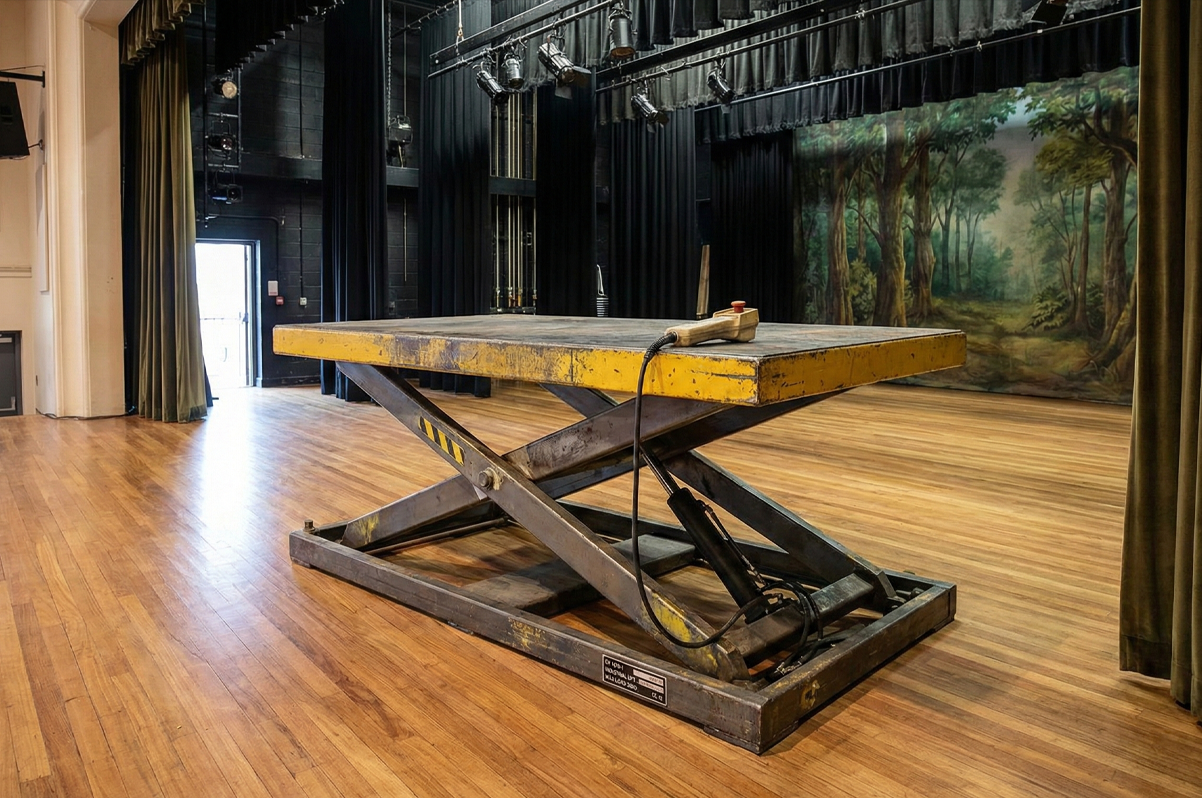
Most lifting tables are built to EN 1570-1. These are designed to move pallets or heavy goods in controlled environments where trained operators are the only people nearby.
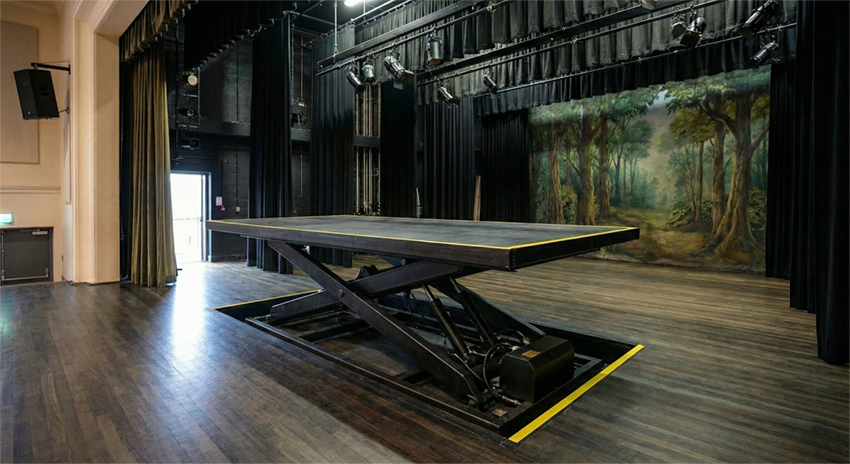
EN 17206, however, is written for the chaos and precision of the theatre. It assumes that heavy loads will move above, below, or alongside performers and audiences. Because the risk to human life is inherently higher, the safety requirements are exponentially more rigorous.
Key Technical Divergences
- Safety Factors: While an industrial lift might use a safety factor of 1.4 to 1.6 on another hand, entertainment standards often demand substantially higher safety factors for load-bearing components.
- Redundancy: EN 17206 often mandates a “No Single Point of Failure” policy. If a single hydraulic hose fails on an industrial lift, a safety valve might catch it. On a stage lift, manufacturers are required to install dual and independent load securing systems to stop movement both ways.
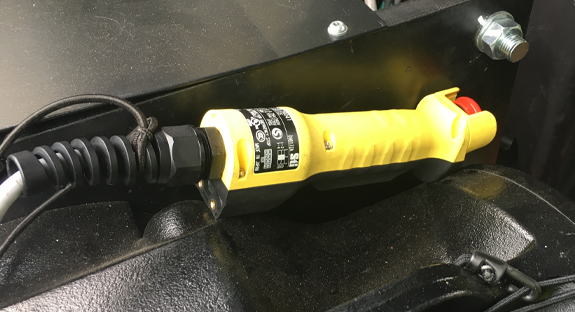
- Control Systems: Industrial lifts use basic “hold-to-run” controls. Stage lifts, and particularly those used to move performers, require high-level Safety Integrity (SIL 3).
Becoming the Manufacturer
This is the most dangerous misunderstanding in the industry. A common misconception is that you can buy a certified EN 1570-1 lift, add a few sensors, and put it on stage. The moment you modify a certified machine without the original manufacturer’s consent; you void its CE/UKCA marking.
Legally, you are no longer an “owner”; you are now the Manufacturer. This means you inherit 100% of the liability. You cannot rely on the original Notified Body’s approval, as that certificate applied to the machine before you altered its safety logic or structural intent. You must now create a new Technical File and issue a new Declaration of Conformity under your own name.
Summarising this point, within the Machinery Directive (and upcoming Machinery Regulation), if you make a “substantial modification”—such as changing the control logic to meet SIL 3, altering the hydraulic safety valves, changing hoses to increase the speed or simply using the lift as it is but changing its intended use —you legally become the Manufacturer.
- The original manufacturer’s warranty and liability vanish
- You must create a new Technical File, perform a new Risk Assessment (EN ISO 12100), and issue a new Declaration of Conformity under your own name.
- If the machine fails and someone is injured, you (and your company) are solely liable.
Reverse Engineering
The most significant hurdle in this conversion is the lack of calculation notes. Original manufacturers rarely share their proprietary stress analyses. To properly assess a machine for EN 17206 without these notes, an engineer must perform an assessment which includes:
- Material Verification: Identifying steel grades via Non-Destructive Testing (NDT) to ensure the base material can handle the stresses.
- Finite Element Analysis (FEA): Re-calculating every pivot point and weld to see if they meet the higher entertainment safety coefficients.
- Dynamic Analysis: Calculating shock loads during an emergency stop—forces that are significantly higher than the static weight of the load.
De-Rating Reality
If you successfully reverse-engineer an industrial lift to meet stage standards, the result is almost always a drastic reduction in load capacity.
Because EN 17206 requires a much higher safety factors, the new manufacturer must lower the allowed weight. A table originally rated for 1,000 kg for industrial use may only be certified for 400 kg or 250 kg on stage. You are essentially reducing the machine’s capacity to fit within the stricter safety margins of the entertainment industry standards.
Is it Worth it?
Reusing an industrial lift for the stage is an exercise in engineering rigor. While it is technically possible to de-rate a machine and upgrade its control to SIL 3, the cost of NDT testing, FEA modeling, and legal recertification often exceeds the price of buying a purpose-built EN 17206 lift from the start.
Alternatively, if you want to integrate your own custom solution, you can purchase a “Partly Completed Machine” (a lift mechanism without controls or hydraulics) and build your EN 17206-compliant system around it. This allows you to integrate the correct safety factors and SIL-rated controls from day one, rather than trying to retrofit them into a finished product that was never designed for events.